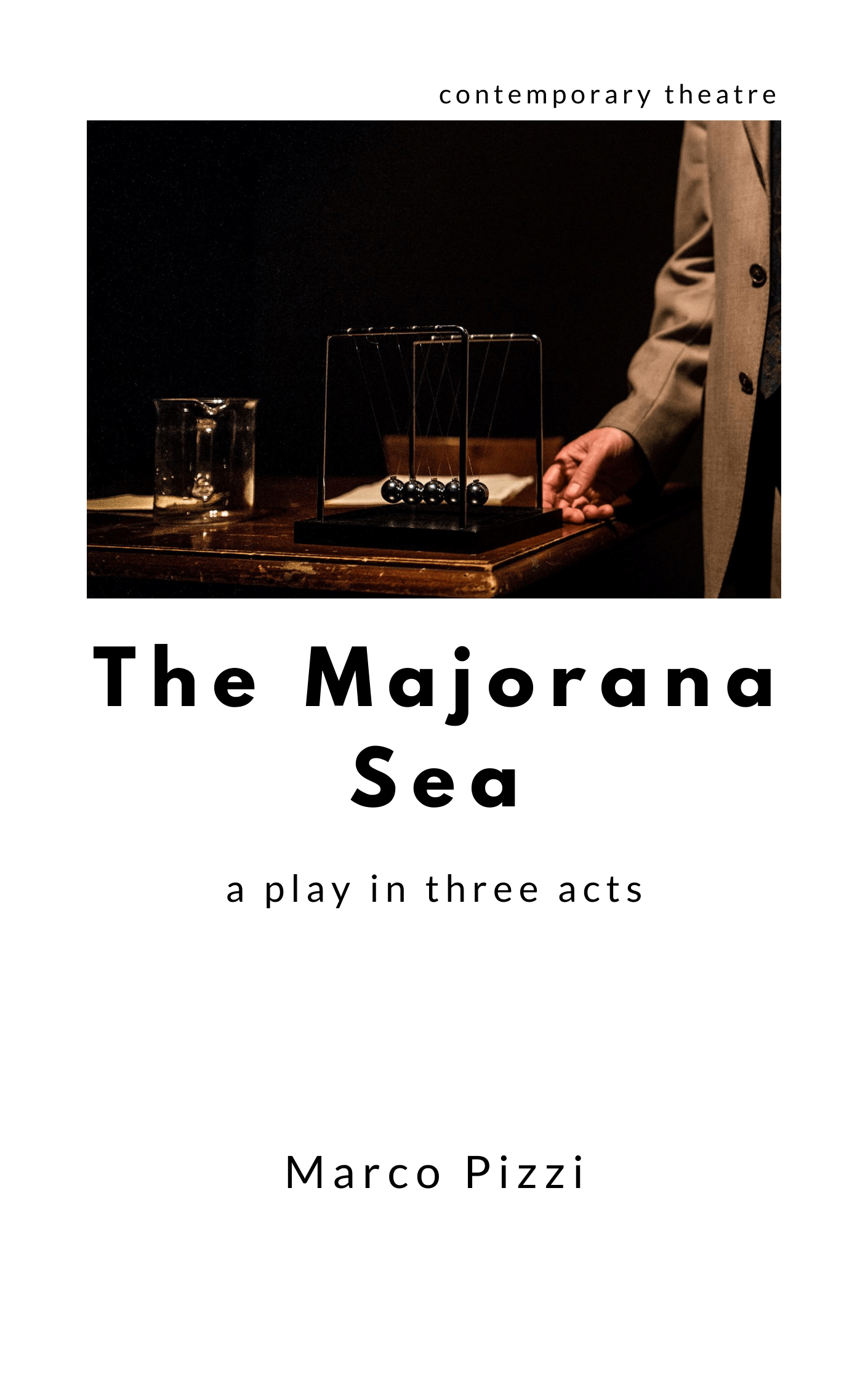
“A compelling reconstruction of an Italian mystery, with a skilful balance between reality and fiction that renders the text enjoyable and captivating.”
Teatro Helios Award at the Passione Drammaturgia festival (Pieve di Teco, Imperia, Italy, 2012).
The next-to-last letter. “Dear Carrelli, I have taken a decision that was inevitable. There is no selfishness in it, but I know the trouble that my sudden disappearance might cause you and the students. So I would ask you please to forgive me for this, but above all for having disappointed the trust, sincere friendship and sympathy that you’ve shown me over the past few months […] ” (From Majorana’s next-to-last letter, Naples, 25 March 1938).
Majorana’s life. The bare public facts of Majorana’s life are briefly told. Born in Catania, Italy, on 5 August 1906, into an important family, he rose rapidly through the academic ranks, became a friend of Fermi, Werner Heisenberg and other luminaries, and produced a few but outstanding papers. Then, beginning in 1933, things started to go terribly wrong. He complained of gastritis, became reclusive, with no official position, and published nothing for several years. In 1937, he submit his last and most long-lasting paper Symmetric Theory of Electron and Positron, which contains also the neutrino’s theory. Then Majorana applied for professorships and was awarded the Chair in Theoretical Physics at Naples, which he took up in January 1938. Two months later, he wrote the above-quoted letter and embarked on a mysterious trip to Palermo. Arrived in Palermo, he wrote another enigmatic letter saying “The sea has rejected me and I will return tomorrow to the hotel in Naples,” but then he disappeared without a trace.
My reconstruction. All the past reconstruction focused their attention mainly on the last days before his disappearance. Instead, my analysis is centered on a fact happened in 1933 and usually neglected: the unexpected discovery of the positron, a real breakthrough which made obsolete Majorana’s infinite-component equation, his most ambitious work (not to be confused with later neutrino’s equation). This fact, in my reconstruction, broke in two parts his scientific and personal life. After that, for four years Majorana no longer frequented the physics department and preferred to live an isolated existence… At this point the play moves from ‘comedy’ to darker and touching drama until the unknown and mysterious final.
Why a play on Majorana. Majorana’s scientific legacy is nowadays greatly recognized, but the deepness of his character goes far beyond the field of physics. He was an outstanding man, sensible and high-cultured, generous and misanthropic, who was well acquainted with Dostoevsky’s novels and Schopenhauer’s philosophy. Further, he dealt with some of the most important physicist of 19thcentury in a crucial period for science and European history. Therefore his life was a perfect mean to treat many interesting topics as frustrated aspirations, misanthropy and misogyny, science and life, genius and ordinary life, troubled friendships, suicide, racial laws, Mussolini and Hitler’s progress etc. But overall, I tried to explore, through the power of theater, the profound ‘sea’ of his soul.
Read The Majorana Sea on Amazon.uk Amazon.com, Amazon.it
Characters of the play
About the author
Marco Pizzi was born in Rome in 1981. He received a degree in physics from University of Rome La Sapienza in 2005, and a PhD. in astrophysics in 2008. After a further period as researcher he turned almost completely to literature. He has written many short stories and two novels: Lucio. Episodes in the Life of an ‘Heretic’ (Lucio. Episodi della vita di un ‘eretico’, 2009), which is a passionate formation novel; and Meeting with Christ. The Philosopher and the Messiah(Incontro con Cristo. Il filosofo e il messia, 2012), which is a historic-philosophical novel about the Gospels. For theater, he has written several plays, among which we remember: Solo con Falcone, a drama about the italian magistrate assassinated by mafia (Special Award, Tragos European Festival 2017). Since 2009 he writes on a blog about theater, literature and opera (from 2020 the blog has migrated to this site).
If you are a producer or you want to give me feedback please contact me at pizzi.mrc@gmail.com
 Marco Pizzi, libri e copioni